Showing posts with label Spanish Lit. Show all posts

Tuesday, December 6, 2011

La Casa de Bernarda Alba and King Lear

In Both "La Casa de Bernarda Alba" (by F. Garcia Lorca), and King Lear, by Shakespeare, there are similar themes that seem to crop up again and again. I feel like they are making commentary on the same ideas, but come to some very vastly different conclusions.

                                                                                              Freedom
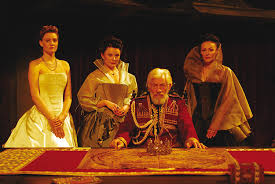
There is something about human nature that makes us want to find and express our own identity. This is so much the case in "La casa de Bernarda Alba" that it causes the eventual death of the youngest daughter of Bernarda, Adela.  All of Bernardas' daughters (who are many) are forced to be cooped up inside the house, not allowed to leave. Never will they be able to leave until they are married, and they must be married off in order. The oldest sister, still unwed at 34, is not having any promising luck until Pepe el Romano comes around. All the other sisters start to boil up in anxiety and lust and want to express themselves-- but they cannot; they are not allowed to. The dictator-mother will not allow this to happen. Eventually, Adela sneaks out and gets together with Pepe. When Bernarda pretends to shoot him and her sister claims that he is dead, she commits suicide--so that finally she can be free. This is one of the major messages of the play: is death really the only way to escape drastic problems?

It seems that Shakespeare addresses the same question. The play ends so tragically that we wonder if there were not any other alternative that could have been more pleasant.


Family 
Bernarda, a single parent, struggles to win the affection of her daughters. She serves as a commentary on Spanish lifestyle in the early 20th Century of keeping private life totally secluded and secret. She must mourn the death of her husband for months, without consolation. With the death of Adela, she tells all of her children to cease from their own sobbing and move on with life, pretending that Adela died a virgin. She never had the love of her children, although the daughters except for Adela, all pretended to give it to keep her happy.

In King Lear, there is also a single parent who at first seeks the love of his children. Two of them make something loquacious up to please him, and Cordelia conceals her true feelings for her father. The other sisters likewise never really love their father, and were only in a scheming plot to benefit themselves just as were the sisters in "La casa de Bernarda Alba" who hoped to get away from their mother by "nicely" putting up a face to isolate themselves for her.


Redemption
There is no redemption, in "La casa de Bernarda Alba", sadly. In King Lear, it is a prominent theme, especially when Edgar and his Father walk the Chalky cliffs of Dover together, and he proceeds with his plan to convince him that he is still very much of great worth. In this aspect the plays differ significantly.


Adversity
Again, here is where Shakespeare and Lorca crash heads. Adversity in "La casa de Bernarda Alba" seems to be built to evoke pity and demonstrate the horrible conditions of family life at this time in Spain. Although family feuds are also prevalent in King Lear, the message seems to be at times a little different. Edgar, with his father, gives the message that: although some trials are so great we cannot understand them, we can still learn to be more compassionate through them. This aspect of Shakespeare is valuable and does not exist in "La casa de Bernarda Alba".


Liberation
Interestingly, Cordelia and Adela both end up hanged. Adela hung herself, though Cordelia never had the choice. Reading the dramatic tones of the plays, however, one almost feels like both females considered that there really was nothing left for them had they stuck around. Were the authors both trying to say that life for them, had they lived, would have been too terrible to take? Is death ever really and answer to these problems?


Posted by Erik on 1:48 PM · Comments (0) ·

Thursday, November 10, 2011

Borges' "Shakespeare's Memory", & criticism


"Quien adquiere una enciclopedia no adquiere cada línea, cada párrafo, cada página y cada grabado; adquiere la mera posibilidad de conocer alguna de esas cosas. Si ello acontece con un ente concreto y relativamente sencillo, dado el orden alfabético de las partes, ¿qué no acontecerá con un ente abstracto y variable, ondoyant et divers, como la mágica memoria de un muerto?" (Borges, 1998).

Found something cool
Borges' "Shakespeare's Memory" is a fantastic short story I happened to stumble across this morning. Interested, I began to research literary criticism on it major themes after devouring the text itself. Though it does not appear to deal thematically with Shakespeare himself, its connection to Shakespeare and the themes that it does bring up are fascinating. I ended up responding myself to the criticism given-- because I realized myself how relevant TO Shakespeare the story was. Although I agree in many respects with the criticism, I feel like it needed to be amplified to be true to Borges' opinion of Shakespeare.

What Borges says, goes
From what I have studied of Borges, his greatest appeal comes from the way he confidently investigates the metaphysical. By its very nature, that which is metaphysical is mysterious and intriguing to us all; looking simply at the quantity and diversity of world religions, the history of philosophy, etc. one realizes humanity cannot be separated with our desire to understand the bigger picture. Because Borges takes these themes down so smoothly and masterfully, it fills our imagination with awe (read "Babel's Library", "The Garden of Forking Paths", etc).

Shakespeare, Borges' hero
 In an interview with Borges, Professor Ted Lyon (of BYU) asked why he didn't ever try to write anything in English, although he was taught it growing up by his grandmother. Borges replied "What, you mean, write in the language of Shakespeare? I wouldn't feel worthy" (see Dr. Lyon for details). It seems that Borges' estimation of Shakespeare is also evident in the short story, which discusses what it would be like to have Shakespeare's memory gradually take over--even replace your own--memories. The short story comments on the nature of reality and memory, and brings up the interesting theme of personal identity.

One of the basic premises of the story is that the brain is like a "palimpsest", that can be written on over and over again, and the current memories and experiences in a way wipe out all of the other aspects of of former self. This is seen when the protagonist loses control of his own faculties to remember and feels memories that he never had.

Criticism
Norma Garza Saldívar's article on the work discussed says that Borges' intent was to describe how memory can be an impetus of personal change (the palimpsest idea):

"El ejercicio de la memoria no se limita a evocar un momento determinado de una historia, no adquirimos con la memoria cada instante de una vida, más bien adquirimos con ella el poder de convocar el pasado para desencadenar una serie de relaciones y posibilidades, para abstraer y proponer con esa memoria otra forma de pensar." (See the article)

Essentially, memory not only serves 'to be there' if we care to remember, but rather to allow us the option of "unchaining the series of relationships and possibilities" to acquire a new way of thinking. That is, because we as human beings are always changing, the way we remember the past can also actually change us. If we were to fully remember the way were were (felt, acted, thought) when we were 8, 18, 28, etc, would we not be likely to change some of the things that we feel now? Would it not be fascinating?

Along these lines, I think that Saldívar's best/major point in his article is the following:


"El Yo para Borges está atravesado por el tiempo, está destinado a ser siempre otro. Un tiempo y un Yo que evocan la imagen de un palimpsesto, como aquel que recuerda Borges en su cuento “La memoria de Shakespeare”."

In other (English) words, our "ego" is a transient entity by nature; it is whimsical and subject to be changed with any wind of influence that passes our way, almost as if we assimilate to anything that presents itself. "It is destined to always be something else", he says, translated, as if it retained no solidarity of personality of its own. Basically, we adapt to our surroundings, whether those surroundings be ideas, languages, memories, etc.

I agree to a certain degree that this is the case, but it is much broader in scope than Saldívar mentions.  That the soul of a person adapts to new circumstances I agree; Saldívar makes an excellent point there. When exposed to an attractive way of thinking that is not our own, I believe that we are prone to comparison. It is the condition as old as "the grass is always greener on the other side of the hill". Now, since the protagonist's life work (in the story) has to do with researching and studying Shakespeare, when he is offered his memory he cannot turn it down. The protagonist is overcome by Shakespeare and essentially becomes Shakespeare. The idea, then, is that (like we mentioned) because he was exposed to the memories powerfully, they became part of him, written on his Palimpsest (it is also important to note that one of the conditions of the story is that one has the option of heeding the memories or not- the encylopedia's pages idea). This is where Saldívar gets his argument.

My argument--that goes beyond Saldívar-- is that Borges believes that the power of Shakespeare himself is great, in and of itself, that is. We already know from a first-hand account that Borges did esteem him highly, the story is further evidence that Borges looked up to the efficacy of Shakespeare's pen. I for one certainly like to interpret the story in the light of how Shakespeare has affected my own life. Shakespeare's style is to present an idea common or Universal to society, and allow us to ponder on its significance in our own lives:

Perhaps there is something that I did a while ago which I have guilt for: then Hamlet would cause me introspection, and then the memories would help me change. Perhaps I have often felt enraged by others' actions and justified my own: then Winters Tale would cause introspection and the memories of my own life associated with it would cause me to change. See, then, how Saldívar is right? We are like Palimpsests that are changed with the writing by memories' resurgence. It is more though, since Shakespeare is the man particularly adept at helping us to do so. THAT is what "Shakespeare's Memory" is all about. I do not believe that this story can be taken out of the context of the importance of Shakespeare.

This is when it all comes back to the quote at the beginning. Borges makes a direct comparison of an Encyclopedia to Shakespeare. If knowledge is possible with the 'memory of books', how much more powerful would it be with the "mágica memoria de un muerto" (magical memory of [Shakespeare]).

It has been a rewarding to look at Shakespeare critically in this way, albeit a round-about way. All that it proves to me is that Shakespeare really is universal.


Posted by Erik on 1:53 PM · Comments (3) ·

Friday, October 21, 2011

Comparative Translation


These are the three texts that I analyzed side by side (feel free to skip over them to the explanation afterward if you wish), of one of my favorite speeches by King Richard II, exhibiting the emotional, depressing experience of losing it all:

Original:

"What must the king do now? Must
he submit?
The king shall do it: must he be deposed?
The king shall be contented: must he lose
The name of king? o’ God’s name, let it go:
I’ll give my jewels for a set of beads,
My gorgeous palace for a hermitage,
My gay apparel for an almsman’s gown,
My figured goblets for a dish of wood,
My sceptre for a palmer’s walking staff,
My subjects for a pair of carved saints
And my large kingdom for a little grave,
A little little grave, an obscure grave;
Or I’ll be buried in the king’s highway,
Some way of common trade, where subjects’ feet
May hourly trample on their sovereign’s head;
For on my heart they tread now whilst I live;
And buried once, why not upon my head?
Aumerle, thou weep’st, my tender-hearted cousin!
We’ll make foul weather with despised tears;
Our sighs and they shall lodge the summer corn,
And make a dearth in this revolting land.
Or shall we play the wantons with our woes,
And make some pretty match with shedding tears?
As thus, to drop them still upon one place,
Till they have fretted us a pair of graves
Within the earth; and, therein laid,—there lies
Two kinsmen digg’d their graves with weeping eyes.
Would not this ill do well? Well, well, I see
I talk but idly, and you laugh at me.
Most mighty prince, my Lord Northumberland,
What says King Bolingbroke? will his majesty
Give Richard leave to live till Richard die?
You make a leg, and Bolingbroke says ay."


Traducción en Verso por Santiago Sevilla


¿Debe el rey ahora someterse?
¿De hacerlo, vanle a deponer?
¿Si ha de aceptarlo, de rey, el nombre
Perderá? ¡Por Dios, lo he de perder!
A cambio de mis joyas, un rosario;
Por mi bello palacio, una ermita;
Por mi túnica dorada, jubón
De mendicante, y por mi cáliz de oro,
Cuenco de madera he de trocar;
Mi cetro, por bordón de peregrino,
Mis siervos, por imágenes talladas,
Mi inmenso reino, por sepultura,
Oscura, o tumba en camino real,
Alguna frecuentada vía,
Donde la gente pise mi frente,
Cual hoy, mi corazón doliente,
A su ida y vuelta, cada día.
Aumerle, lloras, tierno primo.
Con borrasca de lágrimas te oprimo.
La mies caerá ante mis suspiros,
Y eriales haránse los barbechos.
Excaven tumbas nuestras lágrimas
Y veamos, entre dos, quien gana,
Y con ello, conquistemos fama,
Enterrados en la luenga cava,
De ser llorones consumados.
Mas ya veo que digo tontería,
Y merezco que de mi se ría.
Poderoso príncipe Northumberland,
¿Qué manda a decir rey Bolingbroke?
¿Permíteme vivir, hasta que muera?
¿Ordénate Bolingbroke, que digas, sí?

Traduccion de Luis Astrana Marín
Traducida del ingles, 1923  

¿Qué debe hacer el rey ahora? ¿Debe someterse? Lo hará. ¿Debe ser destronado? Quedará satisfecho. ¿Debo perder el nombre de rey? En nombre de Dios, que lo pierda. Daré mis joyas por un rosario, cambiare mi palacio suntuoso por una ermita, mis ricas vestiduras por el traje de un mendigo, mis cubiletes cincelados por un par de santos esculpidos y mi gran reino por una modesta tumba, una más que modesta, modestísima tumba, una oscura tumba; o seré enterrado en el camino real, en una ruta de común tránsito, para que los pies de mis súbditos puedan a todas horas marchar sobre la cabeza de su soberano. Porque bien pisotean mi corazón ahora que vivo, y una vez enterrado, ¿Por qué no han de hacerlo sobre mi cabeza? ¡Lloras, Aumerle, primo de mi corazón! Engendraremos malos tiempos con nuestras lágrimas menospreciadas. Ellas y nuestros suspiros abatirán las mieses estivales y traerán el hambre a este país sublevado. ¿O debemos hacernos los locos con nuestros infortunios y convertir nuestras lágrimas en tema de alguna inda apuesta, por ejemple, dejándolas correr siempre en el mismo sitio, hasta que nos hayan cavado un par de tumbas en la tierra y allí se suscriba: “Aquí yacen dos parientes que cavaron sus tumbas con lágrimas de sus ojos”? Es que este mal no estaría así bien. Bien, bien, ya veo que no digo más que necedades y que os burláis de mí. Milord Northumberland, muy poderoso príncipe, ¿Qué dice el rey Bolingbroke? ¿Su Majestad se digna autorizar a Ricardo a vivir hasta que Ricardo muera? ¿No tenéis que hacer más que una reverencia, y Bolingbroke dirá que sí.


As seen above, the first translation, by Santiago Sevilla, was done in verse. I love the way this one sounds, and it captures almost to a tea the kind of language that Shakespeare used. As one example, Shakespeare employs 9-11 syllables in each line, as done the Spanish translation. The entirety is written iambically (with a few exceptions, both in English and in Spanish). It has a Shakesperian feel to it with the language. Semantically, though... I think it is quite deficient. A few things that are entirely left out, that I think are important are the short phrases:

"What must the king do now?"

"The king shall do it.... [&] The king shall be contented."

"Where subjects’ feet... [&]
May hourly trample on their sovereign’s head


As in the last example, the idea of his subjects overthrowing him is not mentioned. This to me is significant because it is an extra sign if humiliation, which this speech is trying to capture.

Also, in the first examples, some of what seems to me like sarcasm is omitted. Saying that he shall do it cannot be taken at face value if we also look at the quotes where he is blown up emotionally when he thinks about losing it all. And so, we need these few lines to show the bitterness he feels. 

These are just a few examples.

In contrast, the second translation, by Luis Astrana Marín, is very accurate semantically while omitting the elements of verse and iamb. Still, I love the accuracy of meaning here. Take a look at the difference even spatially:

Till they have fretted us a pair of graves
Within the earth; and, therein laid,—there lies
Two kinsmen digg’d their graves with weeping eyes.
Would not this ill do well?

2nd: (literal)
hasta que nos hayan cavado un par de tumbas
en la tierra y allí se suscriba: “Aquí yacen dos parientes 
que cavaron sus tumbas con lágrimas de sus ojos”? 
Es que este mal no estaría así bien.

1st (verse)
Y con ello, conquistemos fama,
Enterrados en la luenga cava,
De ser llorones consumados.

And so, my hypothesis is that you cannot translate accommodating to both the true, full meaning and also the poetry. In this way, it is hard for me to believe that an exemplary translation of Shakespeare's Richard II can be done. Both elements are essential. I imagine that for readers of Shakespeare in Spanish they will just have to take their pick.

Posted by Erik on 11:27 AM · Comments (3) ·

Friday, October 14, 2011

Master Historian, Poet


"How long a time lies in one
little word!
Four lagging winters and four wanton springs 
End in a word:  such is the breath of kings."  

   -Bolingbroke: Richard II, Act I scene iii


"And some will mourn in ashes, some coal-black,
For the deposing of a rightful king."

          - Richard II: Richard II, Act V scene i

           Carlos Navarro Lamarca, in his studies of Shakespeare, has commented that the histories are "marvelously real", and in particular that Richard II demonstrates in itself "clear artistic representations of the idea of history" (see page 377).


           Personally, I was first dubious as to why Shakespeare wrote histories, and so many of them. I think I am starting to seriously be converted, especially after reading the play, and watching the BBC 1978 film adaptation. What captured my attention was how much of human nature really comes out of the text to comment on humanity, even though it all happened so long ago. Richard II comments on honor, power, pride, and self-image in such a way that the characters that tell the story almost become like acquaintances or even friends of ours. I am anxious to more closely examine the characters' lives and try to determine what message exactly Shakespeare is trying to get out. After all, "what else better to uncover the nature of humanity but our own history?" as Averill said.

           Shakespeare is great because he captured the vision of using history as a medium for unearthing humanity. Going back to Lamarca, who titles Shakespeare as a "poet-historian",  we understand that human experience has not ever been totally unique to us. If others have gone before and experienced similar things to those which we have felt, why not read about them and learn from them? It is here that Shakespeare is our asset. He takes us beyond the primary texts and textbooks and teases out the poignancy (through poetry, in this case, as the entire play is in verse) of the events of the past in a way "that elevates humanity much above the tragic or comic face of individual lives" (own transl.).


             Richard, as seen in the quote above, has been dethroned, and suffers several serious crises as a result. Bolingbroke's motivations throughout his ascension also seem to change throughout the play; sometimes he seems to want to simply defend right of law, at other times shows bitter revenge. I want to investigate this a little more.

Posted by Erik on 2:29 PM · Comments (1) ·

Friday, October 7, 2011

Richard II... oh my History


Sat down to think about Shakespeare's Histories. Maybe you have done the same thing recently. I've read Julius Caesar and even played a part in it when I was in 8th grade, but other than that I do not have too much experience in the genre. My first reaction was a list of pessimistic questions, unfortunately:

"Why do histories, Shakespeare? Doesn't seem like a traditional genre for theatre."
"Even if you had a good reason, why write so many?"
"What kind of reaction were you trying to get out of the people?"


C'mon Erik, I thought. This is Shakespeare. There has to be a reason why Shakespeare has chosen the medium of history to present a play. Maybe it is that he finds something sacred about remembering and appreciating the past, or maybe he has a strange fascination with Kings (ever notice how there always seems to be one in every play?). Perhaps there was a demand for it, and he found a way to work it in his own style. I want to find out what motive he had. It must have been powerful, because Richard II is considered as only a part of the larger work of one History-- along with Henry IV part 1, Henry IV part 2, and Henry V. Hmm.

My second reaction, looking at the text, is wondering about why he chose to write this play in nearly all  verse, as opposed to other plays. Would this result in more or less problems for translation of Shakespeare into other languages?

So, I decided to do a little research. It turns out that La Universidad de Alicante, Spain, has a department of English Philology that has compiled over 500 translations of Shakespeare into Spanish from the late 1700s until today. Richard II has been translated significantly at least 7 times since 1870. How cool would it be to do a comparative analysis of the 7 translations (the last one ending in 1998) to determine how the Spanish language itself has evolved in the last century? So many questions...


Posted by Erik on 10:48 AM · Comments (2) ·

Tuesday, October 4, 2011

How far can you go?

              Shakespeare's universality has become more impressive to me after watching for the first time a clip of Love's Labour's Lost translated into Spanish. The "fidelity" of the piece (if we can call it that) with relation to the way that Shakespeare originally presented, is enormously different. Not only is this a Spanish translation with a European flavor, but furthermore the Broadway-like aspect that Kenneth Branagh brings in to it with his year 2000 musical adaption set in the 1930s creates a severely unique environment in for Shakespeare to take on. So, the question is, does the production survive this strange, hostile climate? 

           The stats tell us that though budgeted at $13 million, the production scraped in $299, 972.


           Even though the results popularly say that this was a failure, there are still over 17,000 views on You-tube in the English version and a little more than a fourth of that in Spanish at around 4,300 views. It is really interesting to me that even in the confines of this very unique environment to create Shakespeare, he still is viewed by so many. This is a lesser-known play, some of the casting and setting were very unpopular (though they were intentional) and some of the atmosphere that contributes to this rendition (the fact that it was done in Spanish) makes it even more unique. What is it about Shakespeare that makes him crop up over and over again is so many contexts and "permutations"?  This is a question that I would like to take into further study.

       It is interesting to me that I found this cinematic rendition to be... terribly cheesy. The language of Shakespeare that I most enjoy was not a part at all (or at least barely) of this rendition. The whole aspect of Shakespeare's commenting on rhetoric is totally lost. I love how in Love's Labour's Lost Shakespeare holds up pedantry for consideration. The high and mighty, over-the-top eloquent speech of people like Armado makes us consider whether or not we are using language as a means to an end, or an end in itself. Do we want to sound fancy, or actually say something important? This is a great question I love the play for.

    In the light that I found none of that here, set in a very unique way, how could it still be viewed and appreciated?


Posted by Erik on 2:09 PM · Comments (0) ·

Friday, September 30, 2011

[ʃékspir] = Shakespeare?


             Comparing a comical exchange from Love's Labour's Lost in the original and in a Spanish translation, I have tried to see how efficient translation of Shakespeare into Spanish can be (taken from Act 1 scene 1, when Biron hesitates at first in studying with the King):

English-Original
     FERDINAND:  How well he’s read, to reason against reading!

     DUMAIN:  Proceeded well, to stop all good proceeding!
     LONGAVILLE:  He weeds the corn and still lets grow the weeding.
     BIRON:  The spring is near when green geese are a-breeding.
     DUMAIN:  How follows that?
     BIRON:                  Fit in his place and time.

     DUMAIN:  In reason nothing.
     BIRON:                   Something then in rhyme

Spanish translation

     EL REY.- ¡Qué sabio es, cuando trata de apostrofar a la ciencia!
     DUMAINE.- ¡No se emplearía mejor procedimiento para detener el progreso!
     LONGAVILLE.- ¡Arranca el trigo y deja crecer las malas hierbas!
     BEROWNE.- ¡La primavera está próxima, cuando incuban los tiernos gansos!
     DUMAINE.- ¿Qué se sigue de eso?
     BEROWNE.- Que todas las cosas, en su tiempo y lugar.
     DUMAINE.- Pierde el concepto.
     BEROWNE.- Tanto mejor para la rima


            Something interesting: Shakespeare constantly uses the rhythmic iambic pentameter (here with an extra foot):     u / u / u / u / u / u        as in the phrase: "Proceeded well, to stop all good proceeding!" in Spanish, however, at least in this translation, the meter goes:       u / u / u u / / u u u u u / u u / u / u.        Seems a bit longer, and not as patterned, huh?

            But, I think the biggest difficulty in translation here comes when understanding is lost due to the lack of rhyming. This exchange is supposed to be funny, since we hear the train of related rhyming sentences (in English) before Biron changes the subject entirely while preserving the same rhyme. He then uses this context to make a statement on the importance of rhyme: "Something then in rhyme", he says. This comment still exists in Spanish, but unlike in English there is no previous rhyming to back it up. We could pretty boldly assert that there has been a very important element of Shakespeare lost.

So, one may ask, is the Spanish [ʧékspir], even Shakespeare?


Posted by Erik on 2:28 PM · Comments (1) ·

Friday, September 16, 2011

Anguish


                                                         "/that he did but see
                                                         The flatness of my misery, yet with eyes
                                                         Of pity, not revenge!"
                                                                                 -Hermione, The Winter's Tale


                                     "They would have been friends, but they saw each other only once
                                     face to face, on much-too-famous islands,
                                     and each of them was Cain, and also Abel.

                                     They were buried together.
                                     Snow and corruption know them.

                                     The event I refer to took place at a time we cannot understand"
                                                                        -Jorge L. Borges, "Juan Lopez and John Ward"

     (own tansl.)

Painfully, it seems, Hermione enumerates the things that matter most in her life: (1) the favor of her husband, (2) her first-born, and (3) the child Perdita that was taken away to be "murdered". Shakespeare presents the quintessential situation of agony when all of these are taken way-- and still Hermione maintains her character. She does not blame anyone; she feels overwhelmingly a deep sorrow simply for what is happening.

Borges, who was raised by his English grandmother and called his native Buenos Aires home, must have felt similar anguish when he witnessed the Falklands War (between England and Argentina), which resulted in deaths that to him were certainly not just one-sided.

When conflict arises, do we become angry? Or, as it seems Borges and Shakespeare are, are we genuinely pained by the debauchery inherent in man? I am impressed by the similarity of Shakespeare and Borges in their reactions and hope to internalize this message that they left behind. 


Posted by Erik on 11:24 AM · Comments (2) ·

Wednesday, September 14, 2011

Borges meets Shakespeare


      That's right. In this blog the world-renowned Jorge Luis from La gran Buenos Aires will take center stage. Interestingly enough, in my Spanish Lit class today, we talked to some length about an interview that my professor had with Borges many years ago in Argentina. The subject of the conversation quickly turned to Borges' work, and why he had chosen never to write anything in English (after all, alongside Spanish it had been his native language, although growing up in Argentina). He responded to Dr. Ted Lyon, "What, me? Write in the same language as Shakespeare? You must be kidding."
      Borges was exposed to literature of all kinds, but the fascinating thing is his naturally assumed position in comparative literature. He was never exposed to a bias between either Spanish or English because of his independently studious nature. And yet, above all, he has preferred the master Shakespeare as one of his role models. Another testament to the universality of Shakespeare, even in Hispanic circles.

Posted by Erik on 9:24 PM · Comments (0) ·

Saturday, September 10, 2011

Shakespeare Acculturation

Elements of English culture reflected in Shakespeare's writing (that must have seemed like a second nature to all those listening to his productions) may have had an influence of acculturaton among the hispanic audience. I am interested in finding out to what extent that may have happened-- whether just among the academic sector (in which acculturation is not very likely anyway) or if Shakespeare's influence was actually able to reach and influence a broader audience generally (the way Japanese comics affect American teens). I venture a guess that it is somewhere in between.

Alas. That is not the theme for today really. I wanted to keep it here just as a reminder, so that I can remember the details and come back later.

I love the theme that Shakespeare presents about madness and sanity that seems prevalent in Hamlet. This was the first reaction that I had of something that enjoyed thinking about. This is the thing that I wonder most if has affected at all the cultures of others, actually. It seems such an English thing to me that we overanalyze, become obsessive, and work ourselves up to madness. This was one of the first thoughts that I had while reading him.

 Social interactions in my mind are the best indicator this really happens. The way Hamlet treats his family and "family", the way Claudius treats his wife and his step-son, etc all seem to indicate a lasting tension.

In the Hispanic community that I have come to know well, family relations are not always happy and certainly not blithe, but have a simplicity about them that Hamlet's family certainly does not. I cannot ever recall having dealt with complicated mental or emotional conflict among the Hispanic people with which I served. I wonder if the presentation of these ideas to the Hispanic community ever rubs off.

Posted by Erik on 3:47 PM · Comments (2) ·